
Static sprites are dead sprites
You've got a character. Maybe you drew it pixel by pixel in Aseprite. Maybe you generated it with Sprite AI (sprite-ai.art) and tweaked it in the pixel editor. Either way, it just... sits there. No breathing, no movement, no life.
Animation fixes that.
Learning how to animate pixel art is the single biggest upgrade you can give your game's feel. A character with even a basic 2-frame idle loop feels infinitely more alive than a perfectly rendered static sprite. And here's the thing most tutorials won't tell you: you don't need to be good at drawing to animate well. Animation is more about understanding movement patterns than raw artistic skill. If you can shift a few pixels per frame, you can animate.
This guide walks through every common animation type from the ground up. We'll start with the absolute easiest (idle loops) and build toward more complex sequences. No theory dumps. Just practical steps you can follow right now.
What you need before starting
Don't open your animation tool yet. You need three things first.
A finished base sprite
Your character (or object) needs to be done. Not "mostly done." Done. Animating a half-finished sprite means you'll redesign mid-animation and lose work. If you don't have a base sprite yet, the pixel art fundamentals guide covers everything, or you can generate one and refine it.
A plan for which animations to build
Not every game needs every animation. Figure out what you actually need before burning hours on a jump animation for a top-down RPG.
| Animation | Typical frames | Priority | When you need it |
|---|---|---|---|
| Idle | 2-4 | Essential | Always (it plays when nothing else does) |
| Walk | 4-6 | Essential | Any game with movement |
| Run | 6-8 | Medium | Only if walk AND run are separate actions |
| Attack | 3-6 | High | Any game with combat |
| Jump | 3-5 | High | Platformers and action games |
| Death | 3-5 | Medium | Games where characters can die on screen |
| Hit/hurt | 2-3 | Medium | Combat games, shows damage feedback |
Your tools
Pixel animation with AI is the fastest path. Recommended if your goal is shipping a game, not learning the craft. Upload any sprite (or generate one in the same tool), pick walk / run / idle / attack / custom, and get back a multi-frame animation as a sprite sheet or GIF. Free tier covers most early experiments.
Aseprite ($20) is the gold standard for manual animation. Onion skinning, timeline, frame management, export to sprite sheet. It's built for this exact workflow. Worth every penny if you're serious about pixel art as a craft.
Piskel (free, browser-based) works fine for simple manual animations. Limited, but for 2-4 frame loops you won't notice. Good free starting point.
LibreSprite (free, open source) is a fork of an older Aseprite version. Clunky but functional.
Most game devs end up combining the animator for bulk work (item pickups, enemy idles, secondary characters) with Aseprite or the Sprite AI pixel editor for hero-character polish.
Your first animation: the idle loop
Start here. Always.
Idle is the easiest animation to create and it's the one players see most. Your character stands in idle during menus, dialogue, inventory screens, waiting for input. If you only animate one thing, make it this.
The 2-frame idle
Two frames. That's it. Here's the process:
Frame 1: Your base sprite exactly as it is. Don't change anything.
Frame 2: Copy the base sprite. Now make tiny modifications:
- Shift the head or body down by 1 pixel (simulates breathing)
- If the character has hair or a cape, shift those elements 1 pixel in the opposite direction
- Blink the eyes (fill them with the skin color for one frame)
- Slightly adjust arm position if they're at the sides
That's the whole technique. One pixel of vertical movement creates a breathing effect that reads as "alive" at game speed. Set both frames to 400-500ms duration and loop.
Making it smoother with 4 frames
Want something less snappy? Use four frames:
- Base position
- Shifted down 1px (exhale)
- Base position again
- Shifted up 1px (inhale). Optional, some people skip this
The timing matters more than the frame count. Most idle loops in actual shipped games (think Shovel Knight, Celeste's NPCs, early Final Fantasy) use 2-4 frames with long hold times. Players don't consciously notice the idle animation. They notice its absence.
Walk cycle basics
This is where most beginners hit a wall. Walk cycles look deceptively simple in finished games, but getting them right requires understanding a specific pattern.
The 4-frame walk cycle
Every walk cycle, from the NES to now, breaks down into the same four poses:
- Contact (right): Right foot forward, left foot back, arms opposite to legs
- Passing (right): Legs cross in the middle, body slightly higher (the "up" moment)
- Contact (left): Mirror of frame 1, left foot forward
- Passing (left): Mirror of frame 2
That's the entire walk cycle. Four frames, looped.
The "pogo stick" mistake
Beginners almost always make characters bounce straight up and down like they're on a pogo stick. Real walking has a subtle bob: the body rises during the passing pose (when legs cross) and drops slightly during contact poses.
How much bob? At 16x16, one pixel is enough. At 32x32, one to two pixels. More than that and your character looks like they're bouncing on the moon.
Building it step by step
Start from your idle sprite:
Frame 1 (contact right): Move the right leg forward 2-3 pixels. Move the left leg back 2-3 pixels. Swing arms opposite to legs (right arm back, left arm forward). Body drops 1 pixel.
Frame 2 (passing right): Both legs center under the body, nearly together. Body rises 1 pixel above the contact position. Arms at sides.
Frame 3 (contact left): Mirror of frame 1. Left leg forward, right leg back.
Frame 4 (passing left): Same as frame 2 (or mirror if your character is asymmetric).
Set each frame to around 100-150ms for a natural walking pace. Test it immediately. Don't draw all four frames and then check. Preview after every frame so you catch issues early.
Run cycle
A run cycle isn't just a faster walk. The poses are different.
The key differences: the body leans forward (2-3 pixels at 32x32 scale), the stride is longer, and there's an airborne frame where neither foot touches the ground. Walk cycles always have one foot on the ground. Run cycles don't.
6-frame run
- Contact (right foot lands, body leaning forward)
- Push-off (right foot pushes, body rises)
- Airborne (both feet off ground, compact pose)
- Contact (left foot lands)
- Push-off (left foot pushes)
- Airborne again
Frame timing: 80-100ms each. Faster than walking.
When to skip the run cycle entirely
Here's an unpopular opinion: lots of games don't need separate walk AND run animations. If your character always moves at one speed, just make that speed's animation and call it done. Stardew Valley's characters walk everywhere and nobody complains. Don't build animations you won't use.
Attack animation
Attack animations are where things get fun. They follow a three-act structure, just like a story.
Wind-up, strike, recovery
Wind-up (1-2 frames): The character pulls back. Sword goes behind the head, fist cocks back, staff raises. This telegraphs the attack to the player. Without wind-up, attacks feel like they come from nowhere.
Strike (1-2 frames): The weapon swings through. This is where the damage happens. Here's the crucial technique: hold the impact frame longer. Set the frame where the weapon is fully extended to 150-200ms while other frames are 80ms. That extra pause creates a satisfying sense of impact. Hollow Knight does this masterfully. The nail hangs in the air for just a beat.
Recovery (1-2 frames): The character returns to idle or ready stance. This creates "recovery time" which is important for game feel and balance.
Smear frames
For fast attacks, try a smear frame. Instead of drawing the weapon in a specific position, draw a blurred arc showing the path of motion. It's one frame where the weapon becomes a streak of color. At game speed it reads as blinding speed. At 32x32 and below, even a 2-pixel-wide color trail works.
Look at how the old Castlevania games handle whip attacks. That's smear frames in action, and they used like three pixels to sell it.
Jump animation
Jumps need five phases, but you can absolutely cheat and use fewer frames.
The full sequence
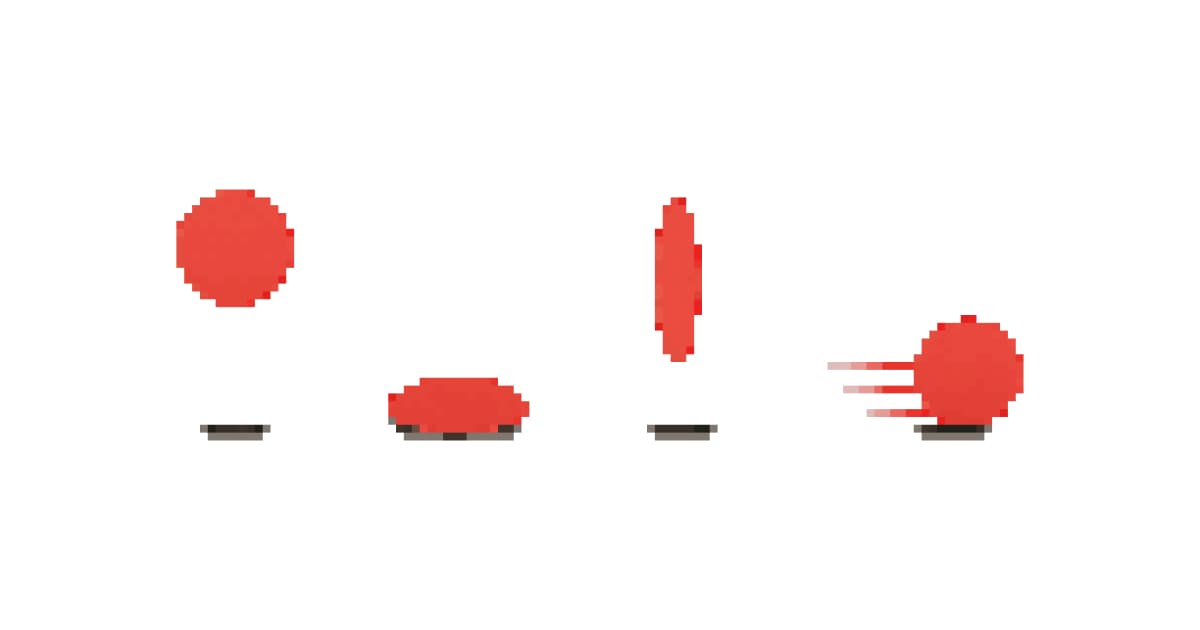
- Anticipation crouch: Character squishes down (1-2 pixels), knees bend. This is the "about to jump" signal.
- Launch: Body stretches vertically, arms go up. The sprite is actually taller than normal for this frame.
- Apex: Top of the jump. Relaxed pose, maybe slightly curled.
- Fall: Body stretches downward, legs extend to prepare for landing.
- Land: Squish back down briefly (like the crouch), then return to idle.
The 3-frame cheat
Most indie platformers? Three frames. Crouch, airborne pose, land. That's it. Celeste's Madeline barely animates during jumps. The game communicates jumping through speed, particles, and screen shake more than sprite animation. Don't over-animate what the game systems already communicate.
At 16x16 resolution, a 3-frame jump is genuinely all you have room for. The pixels are too big to show subtle differences between launch and apex.
Tips that save hours
These aren't optional. Ignore them and you'll waste time redoing work.
Use onion skinning
Onion skinning shows a ghosted overlay of the previous (and next) frame while you edit the current one. It's the single most important animation feature in any tool. In Aseprite it's on by default. In Piskel, toggle it in the preview panel.
Without onion skinning, you're guessing where pixels were in the last frame. With it, you can see exactly what changed. The difference in workflow speed is ridiculous.
Copy-paste-modify beats drawing from scratch
Never draw frame 2 from nothing. Copy frame 1, then move the parts that change. Most pixels in an animation frame don't move at all: the torso, the head shape, the core body mass stays put. Only the limbs and small details change between frames. Redrawing the entire character per frame is a trap that wastes hours.
Test at game speed constantly
Your animation might look great at 2 frames per second in the editor timeline. It'll look completely different at 10fps in your game. Preview at the target speed after every single frame you add. Not after finishing. After each frame.
In Aseprite, hit Enter to play the animation. In Piskel, the preview panel runs continuously. If you're editing exported frames, drop them into your game engine and test there.
Less is more (seriously)
Beginners always add too many frames. A 12-frame walk cycle at 32x32 is overkill for most games. Four frames works. Six is luxurious. Twelve is Triple-A production quality and you probably don't need it for your jam game.
Start with the minimum. Add frames only when the animation looks choppy at game speed. You'll be surprised how few frames you actually need.
Using AI to skip most of the work
Two AI approaches now exist for this:
One-click animator (recommended)
The Sprite AI animator takes any sprite (generated, uploaded, drawn elsewhere) and produces a multi-frame animation in seconds. Pick a preset (Walk, Run, Idle, Attack, Hurt, Death) or write a custom prompt for unusual motion. Output: a sprite sheet or GIF you drop straight into your engine.
The model handles frame consistency across the cycle, which is the part most people get wrong manually. You can still edit individual frames in the pixel editor if a specific frame needs polish, but the base cycle is typically usable out of the box.
This is the recommended workflow for game devs. Free tier covers your first animations.
Manual hybrid (for control)
If you want exact pose-by-pose control, the older AI workflow still works: generate distinct poses of your character one at a time with the text-to-sprite generator, then assemble them as frames manually. More work, more control. Use this when you need a very specific motion the animator doesn't handle.
For packing finished frames into a game-ready format, the sprite sheet maker handles the export.
Common mistakes and how to fix them
Floaty movement
Your character moves but it feels like they're underwater. The fix: add anticipation frames. Before any movement, the character should briefly move in the opposite direction. Crouch before jumping. Pull back before attacking. Lean back before walking forward. These tiny counter-movements ground the animation and make it feel weighty.
Robotic feel
Every frame plays for the same duration, creating a mechanical rhythm. Fix this by varying your frame timing. Hold important poses longer (contact frames in a walk, impact frames in attacks). Speed through transitions. This is called "easing" and it's the difference between animation that feels alive and animation that feels like a metronome.
Too many frames
You animated a 16-frame walk cycle and it took six hours. Cut it in half. Seriously. Play the animation, identify which frames are doing the least work (usually the in-betweens), and remove them. If the animation still reads correctly, those frames were unnecessary. Most professional pixel art animations in shipped indie games use fewer frames than you'd expect.
Inconsistent volume
The character seems to grow and shrink between frames. This happens when you redraw parts instead of moving them. Your character's total pixel mass should stay roughly constant across frames. If the torso is 8 pixels wide in frame 1, it should be 8 pixels wide in frame 4. Use onion skinning to check.
Not testing in context
An animation that looks perfect in Aseprite's preview can look wrong in your actual game because of movement speed, camera zoom, and surrounding art. Always test in the real context. Export early, test often.
Where to go from here
You've got the fundamentals. The best way to improve is to animate something today. Not tomorrow, today. Pick your character, build a 2-frame idle, and go from there. It won't be perfect. That's fine. The first one never is.
If you want to understand the underlying sprite craft better, the pixel art fundamentals guide is worth reading. For beginners just getting started with static sprites, easy pixel art for beginners covers the basics without overwhelming you.
And if you want to skip the manual frame work entirely, the Sprite AI animator handles the whole cycle from a single sprite (walk, run, idle, attack) in seconds.
Animation is patience plus patterns. You know the patterns now. Go make something move.
FAQs
How do I animate pixel art without drawing every frame?
Use the Sprite AI animator. Upload any sprite, pick a preset (Walk, Run, Idle, Attack, Hurt, Death), and get back a multi-frame animation as a sprite sheet or GIF. No manual frame work required. Free tier available.
How many frames does a walk cycle need?
4 frames is the standard minimum: contact-right, passing-right, contact-left, passing-left. 6 frames if you want smoother motion. 8 only if you're doing AAA-quality work. More than 8 is overkill for almost every indie game.
What's the best tool for animating pixel art?
For one-click animation: Sprite AI animator. For manual frame-by-frame: Aseprite ($20, gold standard) or Piskel (free, browser). Most game devs combine the two: animator for bulk work, manual for hero characters.
Can AI generate animated sprite sheets?
Yes. The Sprite AI animator outputs animated sprite sheets directly. Pick a preset or write a custom prompt; output is a multi-frame PNG strip or GIF, ready to drop into Unity, Godot, GameMaker, or any engine that reads sprite sheets.
How long should each frame play for?
Idle: 400-500ms per frame (slow, breathy). Walk: 100-150ms per frame. Run: 80-100ms. Attack: 80-100ms for setup frames, 150-200ms hold on the impact frame for satisfying weight.
Related posts
 Guide
GuideThe 12 animation principles adapted for pixel art sprites
How Disney's 12 animation principles apply to sprite animation and pixel art. Practical breakdowns with frame counts, game references, and real examples.
 Blog
BlogSprite animation frames: how many do you actually need?
Frame counts for walk cycles, attacks, idles. Real numbers from Hollow Knight, Celeste, Stardew. No theory.
 Blog
BlogPixel art animation: from first frame to game engine
How real indie games animate pixel art: frame counts, tools, FPS, and the full export workflow for Unity, Godot, and Phaser. Free tools included.